
Investment Performance
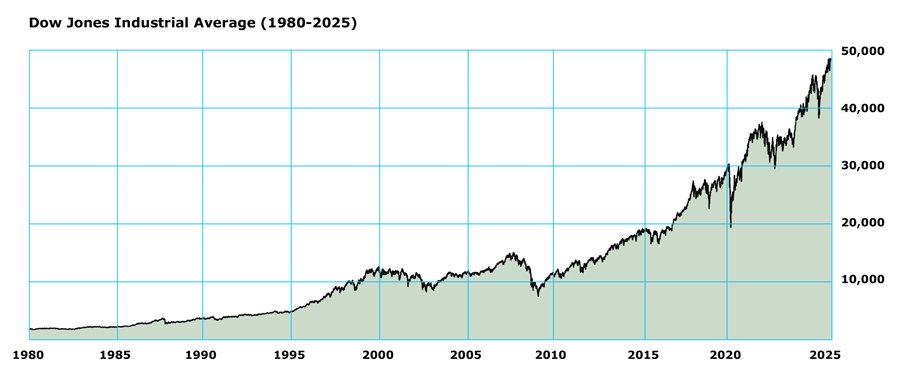
We encourage our clients to take a long-term view when investing in the stock market. By “long-term,” we do not necessarily mean 10 or 20 years—although in some cases that timeframe is appropriate. Rather, true investors look beyond any single quarter or year, whether the market environment is good or bad.
For example, as difficult as the year 2000 was—and it was indeed a dreadful year—it was only the first time since 1990 that all three major market indices—the DOW, NASDAQ, and S&P 500—declined in the same year.
Another perspective is the October 1987 market crash, when the DOW fell 22% in a single day, dropping from roughly 2,200 to 1,700. In today’s market, that would be equivalent to a decline of approximately 2,700 points in one day. During the uncertainty of 1987, few could have imagined the DOW reaching 10,000. Yet, in 2010, it stood at approximately 12,500—more than seven times higher than the 1987 low of 1,700.
More recently, from 2010 through 2025, the DOW has continued its long-term upward trend despite several temporary disruptions, including:
- 2010–2012 — Eurozone debt crisis
- 2015–2016 — China slowdown and oil market collapse
- Late 2018 — Federal Reserve interest-rate tightening
- 2020 — COVID-19 pandemic
These declines were driven by external shocks rather than a structural collapse of corporate America.
The key takeaway is that while markets will inevitably experience volatility and periodic bear markets, long-term economic innovation, earnings growth, and policy responses have historically supported the market’s overall upward trajectory.
At Fieldstone Money Management, we strongly believe that disciplined participation in the stock market is one of the most effective ways to build wealth over time. We are committed to helping our clients achieve that goal.
